x402 Facilitators:
List & Comparison
The facilitator is the engine that verifies and settles x402 payments. Below is a curated list of real facilitators — hosted and self-hosted — across Base, Solana and EVM chains, with live stats from the 112+ facilitator projects we track.
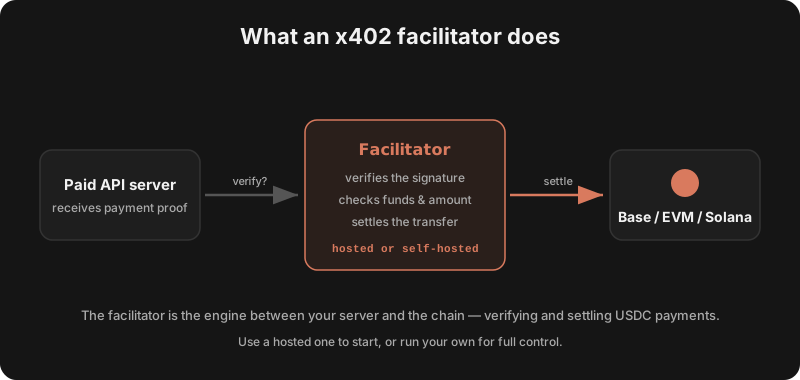
What does a facilitator do?
When an AI agent pays for a resource over x402, it sends a signed payment payload back to the server. The server doesn't talk to the blockchain directly — it forwards that payload to a facilitator, which:
- Verifies the payment signature and amount are valid.
- Settles the USDC transfer on-chain (e.g. via EIP-3009).
- Confirms back to the server so it can release the resource.
The server-side piece that gates requests and talks to a facilitator is the x402 payment gateway.
Hosted vs. self-hosted
The facilitator list
Curated real implementations · stars are live from GitHub · sorted by popularity.
A payments protocol for the internet. Built on HTTP.
Accept payments from AI agents. Open-source. Your data, your domain, your rules. Free forever.
A production-ready payment settlement service for the x402 protocol. Built with Elysia and Node.js, it verifies cryptographic payment signatures and settles transactions on-chain for EVM, SVM (Solana), and Starknet networks.
The Decentralized Facilitator for Agentic Payments
Golang implementation of an x402 payment facilitator
Run your own payment gateway as a Docker image, or use ours online to verify and settle x402 transactions instantly.
x402 facilitator-client-ts
X402 payment facilitator for AI API billing with Solana USDC and Base USDC support.
How to choose
Want to ship today?
Use the hosted Coinbase CDP facilitator on Base. Least setup, fastest to a working paywall.
Need data ownership?
Self-host an open-source facilitator (Rust/Go/TS/Java) so settlement runs on your own infrastructure.
Building on Solana?
Pick a multi-chain facilitator that settles Solana USDC, not just Base.
Frequently asked questions
What is an x402 facilitator?
A facilitator is the service that verifies a payment payload and settles it on-chain on behalf of a resource server. It lets your API accept x402 payments without writing your own settlement and verification logic — the server forwards the signed payment to the facilitator, which checks it and broadcasts the USDC transfer.
Is there an official x402 facilitator?
Yes. Coinbase ships the reference x402 protocol and a hosted CDP facilitator, which is what most projects use to get started on Base. You can also self-host a facilitator if you want to own the settlement path.
Can I run my own (self-hosted) facilitator?
Yes. Several open-source facilitators (in Rust, Go, TypeScript and Java) let you run settlement on your own infrastructure for control, privacy and custom chains. See the self-hosted options listed above.
Is there an x402 facilitator for Solana?
Yes — some facilitators support Solana USDC in addition to Base. Multi-chain facilitators handle settlement across more than one network; the list above flags chain support per project.
How do I choose a facilitator?
If you want the fastest path on Base, start with the hosted Coinbase CDP facilitator. If you need data ownership, custom chains, or no third-party dependency, pick a self-hosted open-source facilitator in your stack’s language (Rust, Go, TS, Java).
What is the x402 facilitator URL?
The facilitator URL is the HTTP endpoint your resource server points to for the /verify and /settle calls. If you use a hosted facilitator (like Coinbase CDP), you configure the URL it provides in your x402 middleware. If you self-host, the facilitator URL is simply the address of your own deployed facilitator server. The exact hosted endpoint is documented by your provider — always copy it from their official docs rather than hard-coding a guessed value.