
x402
A payments protocol for the internet. Built on HTTP.
In the AI payments ecosystem
x402 is a widely-adopted TypeScript project in the AI payments / x402 ecosystem. It currently has 6,373 GitHub stars and 147 forks.
Our take
This is the reference implementation of the x402 protocol — the repo that defined the standard most of this directory builds on. Maintained by Coinbase, it packages the HTTP 402 "Payment Required" handshake into production middleware and client libraries, with USDC settlement on Base and other EVM chains plus Solana support.
If you are evaluating x402 for the first time, start here rather than with a third-party SDK: the spec, the examples and the reference facilitator all live in this repository, so what you read is what the ecosystem actually implements. The TypeScript tooling is the most complete; other languages are covered by community SDKs that track this repo.
Best for: any team adding pay-per-request monetization to an API or MCP server. Pair it with a hosted facilitator if you do not want to operate settlement yourself — see the projects in our facilitators category.
Note: We've moved the x402 repo under the x402 Foundation repo. All issues and PRs were transferred here: github.com/x402-foundation/x402
Our repo (coinbase/x402) is now a development fork.
x402
x402 is an open standard for internet native payments. It aims to support all networks (both crypto & fiat) and forms of value (stablecoins, tokens, fiat).
app.use(
  paymentMiddleware(
    {
      "GET /weather": {
        accepts: [...],                 // As many networks / schemes as you want to support
        description: "Weather data",    // what your endpoint does
      },
    },
  ),
);
// That's it! See examples/ for full details
Installation
Typescript
See all the packages available in the Typescript SDK, including chain implementations of x402, code examples and integration guides.
# All available reference sdks
npm install @x402/core \
  @x402/evm @x402/svm @x402/stellar @x402/svm \
  @x402/axios @x402/fastify @x402/fetch @x402/express @x402/hono @x402/next @x402/paywall @x402/extensions
# Minimal Fetch client
npm install @x402/core @x402/evm @x402/svm @x402/fetch
# Minimal express Server
npm install @x402/core @x402/evm @x402/svm @x402/express
Go
See the
go/folder for code examples and integration guides.
go get github.com/x402-foundation/x402/go
Principles
- Open standard: x402 is an open standard, freely accessible and usable by anyone. It will never force reliance on a single party.
- HTTP / Transport Native: x402 is meant to seamlessly complement existing data transportation. It should whenever possible not mandate additional requests outside the scope of a typical client / server flow.
- Network, token, and currency agnostic: we welcome contributions that add support for new networks (both crypto and fiat), signing standards, or schemes, so long as they meet our acceptance criteria laid out in CONTRIBUTING.md. x402 may extend support to fiat based networks, but will never deprioritize onchain payments in favor of fiat payments.
- Backwards Compatible: x402 will not deprecate support for any existing networks unless such removal is deemed necessary for the security of the standard. Whenever possible, x402 will aim for backwards compatibility for non-major version changes.
- Trust minimizing: all payment schemes must not allow for the facilitator or resource server to move funds, other than in accordance with client intentions
- Easy to use: It is the goal of the x402 community to improve ease of use relative to other forms of payment on the Internet. This means abstracting as many details of crypto as possible away from the client and resource server, and into the facilitator. This means the client/server should not need to think about gas, rpc, etc.
Ecosystem
The x402 ecosystem is growing! Check out our ecosystem page to see projects building with x402, including:
- Client-side integrations
- Services and endpoints
- Ecosystem infrastructure and tooling
- Learning and community resources
Want to add your project to the ecosystem? See our demo site README for detailed instructions on how to submit your project.
Roadmap: see ROADMAP.md
Documentation: see docs/ for the GitBook documentation source
Terms:
resource: Something on the internet. This could be a webpage, file server, RPC service, API, any resource on the internet that accepts HTTP / HTTPS requests.client: An entity wanting to pay for a resource.facilitator: A server that facilitates verification and execution of payments for one or many networks.resource server: An HTTP server that provides an API or other resource for a client.
Technical Goals:
- Permissionless and secure for clients, servers, and facilitators
- Minimal friction to adopt for both client and resource servers
- Minimal integration for the resource server and client (1 line for the server, 1 function for the client)
- Ability to trade off speed of response for guarantee of payment
- Extensible to different payment flows and networks
Specification
See specs/ for full documentation of the x402 standard/
Typical x402 flow
x402 payments typically adhere to the following flow, but servers have a lot of flexibility. See advanced folders in examples/.
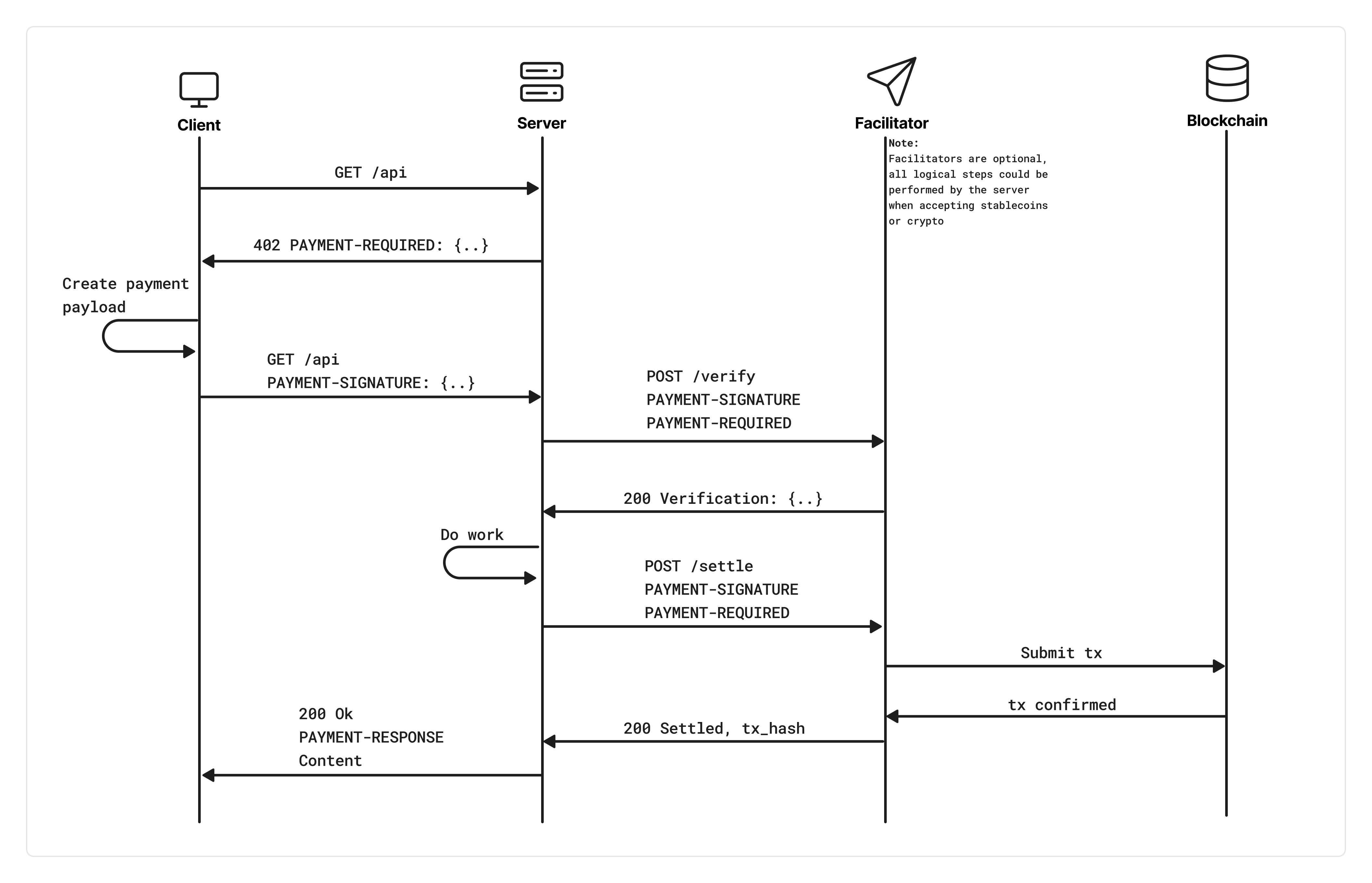
The following outlines the flow of a payment using the x402 protocol. Note that steps (1) and (2) are optional if the client already knows the payment details accepted for a resource.
Clientmakes an HTTP request to aresource server.Resource serverresponds with a402 Payment Requiredstatus and aPaymentRequiredb64 object return as aPAYMENT-REQUIREDheader.Clientselects one of thePaymentRequirementsreturned by the server response and creates aPaymentPayloadbased on thescheme&networkof thePaymentRequirementsthey have selected.Clientsends the HTTP request with thePAYMENT-SIGNATUREheader containing thePaymentPayloadto the resource server.Resource serververifies thePaymentPayloadis valid either via local verification or by POSTing thePaymentPayloadandPaymentRequirementsto the/verifyendpoint of afacilitator.Facilitatorperforms verification of the object based on theschemeandnetworkof thePaymentPayloadand returns aVerification Response.If the
Verification Responseis valid, the resource server performs the work to fulfill the request. If theVerification Responseis invalid, the resource server returns a402 Payment Requiredstatus and aPayment Required ResponseJSON object in the response body.Resource servereither settles the payment by interacting with a blockchain directly, or by POSTing thePayment PayloadandPayment PaymentRequirementsto the/settleendpoint of afacilitator server.Facilitator serversubmits the payment to the blockchain based on theschemeandnetworkof thePayment Payload.Facilitator serverwaits for the payment to be confirmed on the blockchain.Facilitator serverreturns aPayment Execution Responseto the resource server.Resource serverreturns a200 OKresponse to theClientwith the resource they requested as the body of the HTTP response, and aPAYMENT-RESPONSEheader containing theSettlement Responseas Base64 encoded JSON if the payment was executed successfully.
Schemes
A scheme is a logical way of moving money.
Blockchains allow for a large number of flexible ways to move money. To help facilitate an expanding number of payment use cases, the x402 protocol is extensible to different ways of settling payments via its scheme field.
Each payment scheme may have different operational functionality depending on what actions are necessary to fulfill the payment.
For example exact, the first scheme shipping as part of the protocol, would have different behavior than upto. exact transfers a specific amount (ex: pay $1 to read an article), while a theoretical upto would transfer up to an amount, based on the resources consumed during a request (ex: generating tokens from an LLM).
See specs/schemes for more details on schemes, and see specs/schemes/exact/scheme_exact_evm.md to see the first proposed scheme for exact payment on EVM chains.
Schemes vs Networks
Because a scheme is a logical way of moving money, the way a scheme is implemented can be different for different blockchains. (ex: the way you need to implement exact on Ethereum is very different from the way you need to implement exact on Solana).
Clients and facilitators must explicitly support different (scheme, network) pairs in order to be able to create proper payloads and verify / settle payments.
More Coinbase projects
All Coinbase projects →


Self-healing infrastructure for AI agent payments. 90.3% auto-recovery.


Daydreams is a set of tools for building agents for commerce


The best way to monetize AI applications & MCP, using x402, CDP Smart Wallets & Paymaster


URL shortener


AWS payment demo of x402 using Bedrock AgentCore, Strands SDK, and CloudFront.


Cloudera CDP SDK for Java
