
portal-tunnel
Publishes localhost services to the agentic web through self-hostable, trustless relays with x402 payments.
In the AI payments ecosystem
portal-tunnel is an established Go project in the AI payments / x402 ecosystem, focused on agentic-web, e2ee, nat-traversal, ngrok-alternative. It currently has 264 GitHub stars and 27 forks, and sits alongside related tools like os-moda, agentanycast, PayForApi, X402-audio-to-audio, sample-agentcore-cloudfront-x402-payments, spritz.
Our take
portal-tunnel publishes localhost services to the agentic web through self-hostable, trustless relays — with x402 payments built in. Think ngrok, but E2E-encrypted, self-hostable, and natively payable.
This solves a real distribution problem for agent services: the best tool server may live on a laptop or behind a NAT, and agents still need to reach (and pay) it. Trustless relays mean the tunnel operator cannot read your traffic; x402 means the relay and the service can both charge per use. It is a small but important piece of agent-web plumbing.
Best for: developers exposing local or self-hosted services to paying agents without a public IP.
Portal - Self-Hostable Relay Tunnel for Localhost
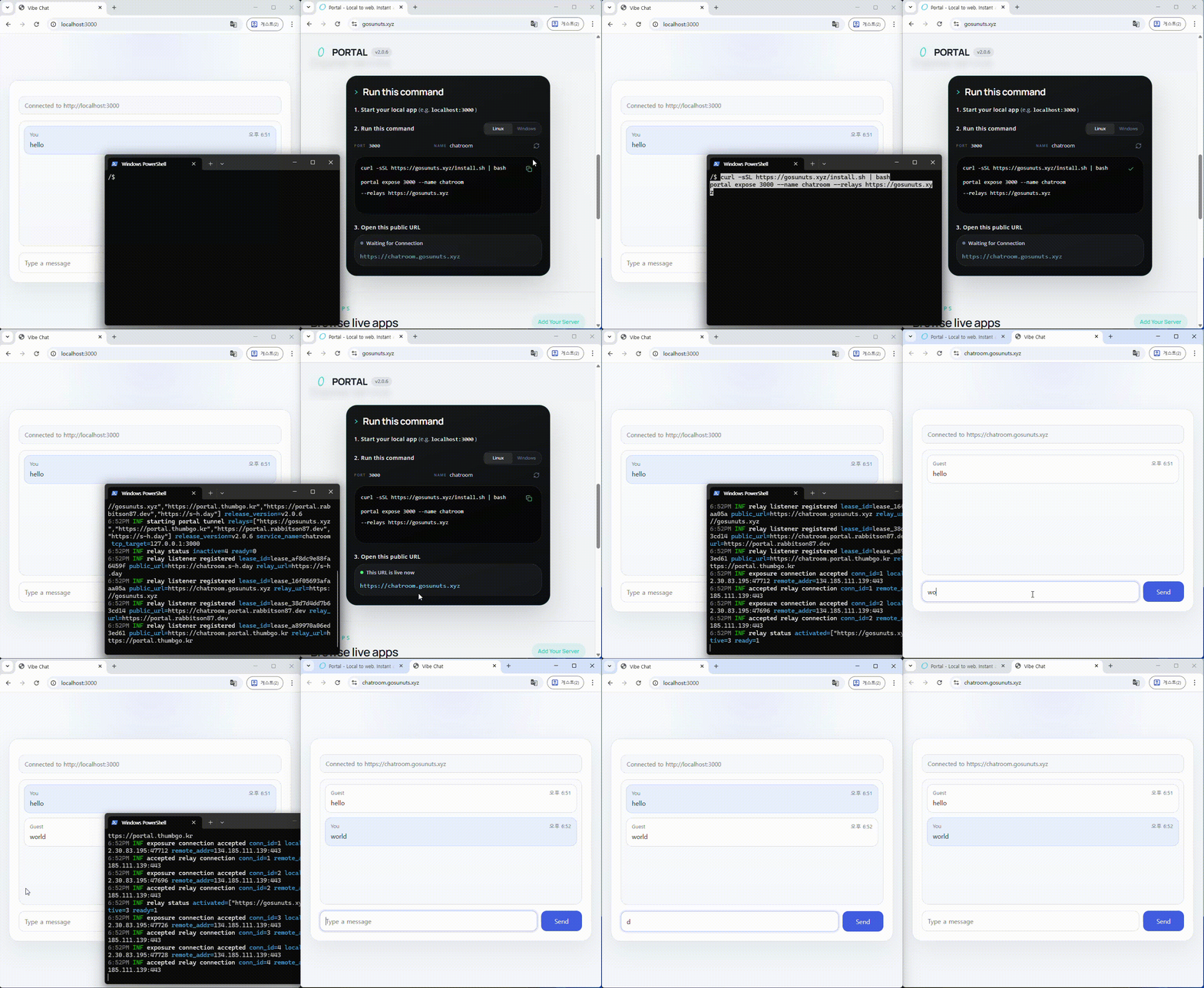
Expose local services through self-hosted or public relays.
No port forwarding. No inbound firewall rules. No manual DNS setup. No accounts.
Why Portal?
Portal is a local tunnel runtime and relay network for publishing services to the agentic web. It publishes local apps, APIs, tools, and agents through self-hosted or public relays, keeps routing and x402 payment policy in the tunnel process, and avoids requiring a hosted vendor account.
Self-Hostable, Fully Open Source - Run your own relay with a single command. The relay is MIT-licensed with no enterprise tier, no feature gating, and no call-home. Your relay, your rules.
Anonymous Relay Network - Connect to public relays without a hosted account or central operator. Combine self-hosted relays with public relays in a pool to split trust across independent operators you choose.
End-to-End Tenant TLS And ECH - Because relays are trustless, Portal terminates tenant TLS at the user's endpoint instead of the relay. Portal also provides ECH to avoid exposing the real hostname in plaintext SNI.
Built-in MITM Detection - Portal actively self-probes its own connection after real traffic begins. It compares TLS keying material exported on both sides and treats a mismatch as suspected relay-side TLS termination.
Multi-Hop Relay Routing - Chain multiple relays together so no single relay knows both the origin and the destination. Use
--multi-hop-depth 3to select a three-hop route automatically.No Accounts, No API Keys - Authentication uses SIWE-compatible signing with a locally generated secp256k1 key pair. No email, no registration, no vendor lock-in.
Built-in x402 Payments - Routed HTTP paths can require Sui gasless USDC x402 payment before proxying. Browser apps can import
/x402/client.js, and native clients can call/x402/preparedirectly and sendX-PAYMENT.
Comparison
| Portal | ngrok | Cloudflare Tunnel | frp | |
|---|---|---|---|---|
| Public localhost URL | Yes | Yes | Yes | Yes |
| Self-hostable | Yes | Enterprise only | No | Yes |
| Open source | MIT | No | Client only | Apache 2.0 |
| Custom domain | Yes | Paid plans | Yes | Yes |
| End-to-end tenant TLS | Yes | No | No | No |
| SNI hiding (ECH) | Yes | No | No | No |
| MITM self-probe | Built-in | No | No | No |
| Multi-relay failover | Yes | Managed | Built-in | No |
| Multi-hop routing | Yes | No | No | No |
| Account required | No | Yes | Yes | No |
| Native x402 payments | Yes | No | No | No |
Quick Start
Expose a local service
macOS / Linux:
curl -fsSL https://github.com/gosuda/portal-tunnel/releases/latest/download/install.sh | bash
portal expose 3000
Windows (PowerShell):
$ProgressPreference = 'SilentlyContinue'
irm https://github.com/gosuda/portal-tunnel/releases/latest/download/install.ps1 | iex
portal expose 3000
Portal prints a public HTTPS URL for your local app instantly. More examples:
# Custom name and relay
portal expose 3000 --name myapp --relays https://portal.example.com --discovery=false

# Mount frontend and API behind one URL
portal expose --name myapp \
  --http-route /api=http://127.0.0.1:3001 \
  --http-route /=http://127.0.0.1:5173

# Require Sui USDC x402 payment before proxying a route
portal expose --name paid-app \
  --http-route "/paid=http://127.0.0.1:3001 GET:0.01" \
  --http-route /=http://127.0.0.1:5173 \
  --x402-pay-to 0x...

# Raw TCP port (Minecraft, databases, SSH)
portal expose localhost:25565 --name minecraft --tcp

# Three-hop route for maximum anonymity
portal expose 3000 --multi-hop-depth 3
See CLI Reference for the full route syntax and API Reference for the x402 helper endpoints.
Keep tunnels running with Portal Agent
Use portal agent run when tunnels should keep running outside your terminal.
It runs as a local OS service, keeps every tunnel in one TOML config alive, and
provides a dashboard for relay and multi-hop management.
portal agent run --config config.toml
portal agent dashboard --config config.toml
portal agent restart
portal agent stop

# Foreground mode skips OS service installation.
portal agent run --config config.toml --foreground
See Portal Agent for the config format.
Run your own relay
git clone https://github.com/gosuda/portal-tunnel
cd portal-tunnel && cp .env.example .env
docker compose up
For public deployment with DNS automation (ACME), TCP/UDP port ranges, and relay policy, see Deployment.
How End-to-End Encryption Works
Browser
  -> Relay SNI router  (reads only routing token, forwards raw bytes)
  -> Reverse session
  -> Portal tunnel     (performs TLS handshake locally, derives session keys)
  -> Local service
- The relay accepts the incoming connection and reads only the TLS ClientHello for SNI-based routing.
- It forwards the raw encrypted stream over the reverse session without terminating TLS.
- The Portal tunnel on your side completes the TLS handshake locally. Session keys are derived on your machine.
- For relay-hosted domains, the tunnel obtains certificate signatures via
/v1/sign, using the relay only as a keyless signing oracle. The relay signs handshake digests but never receives session keys. - After the handshake, the relay continues forwarding ciphertext without access to plaintext.
When ECH is enabled, the relay also cannot see the actual tenant hostname. It routes by an opaque token derived from the tunnel identity, while the real SNI stays inside the ECH-protected ClientHello.
How Multi-Hop Routing Works
Browser
  -> Entry relay  (sees only the opaque route hostname)
  -> Middle relay (sees only the next-hop token)
  -> Exit relay   (sees only the reverse session token)
  -> Portal tunnel
  -> Local service
Each relay in the chain knows only its immediate neighbors. No single relay holds the full path. Tenant TLS still terminates only on your side, so no relay in the chain receives tenant TLS plaintext.
Public Relay Registry
Portal's official public relay registry is:
https://raw.githubusercontent.com/gosuda/portal-tunnel/main/registry.json
Tunnel clients include this registry by default. If you operate a public Portal
relay, open a pull request to add your relay URL to registry.json.
Documentation
- CLI Reference
- Concepts
- Portal Agent
- Wallet and ENS
- Security Model
- Architecture
- Deployment
- Configuration Reference
Contributing
- Fork the repository.
- Create a feature branch (
git checkout -b feature/amazing-feature). - Make the change with focused tests or docs.
- Open a pull request.
License
MIT License - see LICENSE.
Similar projects


An operating system built for AI agents — talk to your NixOS server instead of SSH-ing in. Typed, audited tool access with atomic rollback on every change. Research-grade; run it on a disposable box, not production.


Connect AI agents across any network — zero config, encrypted, skill-based routing


No description.


Transmits signed USDC payments over sound using a custom OOK audio modem with Goertzel detection. Compresses x402 handshakes to 138 bytes, settling on Base through 36 seconds of 2400 Hz beeping.


AWS payment demo of x402 using Bedrock AgentCore, Strands SDK, and CloudFront.


Spritz is a decentralized, permission-less and censorship resistant chat app for web3. Connect with friends using passkeys or wallets. Make HD video calls, go live to your followers, and chat freely on a decentralized network.

More Go projects
All Go libraries →

Your AI trading terminal assistant for US stocks, commodities, forex, and crypto.


Golang SDK for A2A Protocol


Building blocks for Agentic payments (x402, MPP, AP2) for TypeScript, Rust, Go, Python, Ruby, PHP, Lua, Kotlin and Swift.


Building blocks for Agentic payments (x402, MPP, AP2) for TypeScript, Rust, Go, Python, Ruby, PHP, Lua, Kotlin and Swift.

Go implementation of the x402 payment protocol


URL shortener
