
openclaw-usdc-hackathon-2026
OpenClaw USDC Hackathon 2026: Agent-to-Agent Payments via x402 Protocol
In the AI payments ecosystem
openclaw-usdc-hackathon-2026 is an early-stage TypeScript project in the AI payments / x402 ecosystem. It currently has 0 GitHub stars and 0 forks.
Agent-to-Agent USDC Payments Demo
OpenClaw USDC Hackathon 2026 Submission
A working demonstration of autonomous agents exchanging USDC payments for services using the x402 payment protocol on Base Sepolia testnet.



🎯 Overview
This project demonstrates agent-to-agent economic transactions where AI agents can:
- Discover services offered by other agents
- Request and pay for services automatically using USDC
- Receive payments for services provided
- Execute tasks only after payment verification
Key Innovation: Autonomous agents conducting economic transactions without human intervention, powered by the x402 HTTP payment protocol and USDC stablecoin.
✅ Submission
Everything needed to submit (minus the actual video recording) is packaged in-repo.
Start here (copy/paste submit):
SUBMIT-NOW.md— one page with final steps + form fields
Core submission docs:
SUBMISSION.md— full submission guideSUBMISSION-CHECKLIST.md— quick checklistRELEASE.md— GitHub Release draft checklist + suggested tag
Assets you still need to produce (human):
CODE-WALKTHROUGH-VIDEO-SCRIPT.md— record the walkthrough; paste the link into README +SUBMIT-NOW.mdLOCAL-DEMO-SCREENSHOT-PLAN.md— exact screenshot list (place images inassets/screenshots/)
🏗️ Architecture
System Overview

Payment Flow
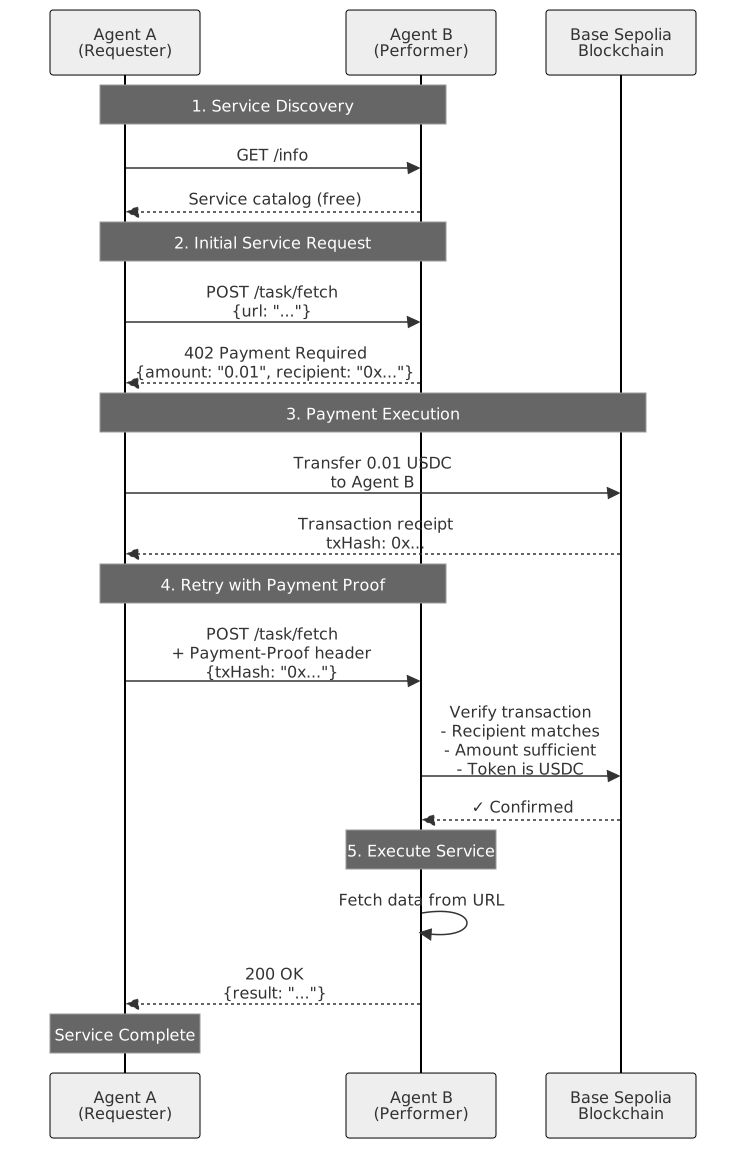
Sequence Diagram
┌─────────────────────┐              ┌─────────────────────┐
│   Agent A           │              │   Agent B           │
│   (Requester)       │              │   (Performer)       │
│                     │              │                     │
│  1. Discover        │────GET────▶  │  /info              │
│     services        │              │  (free endpoint)    │
│                     │              │                     │
│  2. Request task    │───POST────▶  │  /task/*            │
│     + payment proof │              │  (paid endpoint)    │
│                     │              │                     │
│                     │  ◀──402───   │  Payment Required   │
│                     │              │  (x402 response)    │
│                     │              │                     │
│  3. Transfer USDC   │              │                     │
│     on Base Sepolia │──────────────▶ Blockchain          │
│                     │              │                     │
│  4. Retry request   │              │                     │
│     with proof      │───POST────▶  │  Verify payment     │
│                     │              │  Execute task       │
│                     │              │                     │
│                     │  ◀──200───   │  Return result      │
│  5. Receive result  │              │                     │
└─────────────────────┘              └─────────────────────┘
Components
Agent A (Requester) -
src/agent-a-requester.ts- Discovers available services
- Initiates payment-protected requests
- Automatically handles x402 payment flow
- Built with
@x402/fetchSDK
Agent B (Performer) -
src/agent-b-performer.ts- Provides three types of services
- Protects endpoints with x402 payment middleware
- Verifies payments on Base Sepolia blockchain
- Built with
@x402/expressSDK
x402 Protocol
- HTTP 402 Payment Required standard
- Automatic payment negotiation
- Blockchain payment verification
- Seamless retry with payment proof
💡 Use Cases
This demo includes three real-world service examples:
1. Data Fetch Service ($0.01 USDC)
Agent A pays Agent B to fetch data from any URL.
Use case: API aggregation, web scraping, data collection services
npm run agent-a -- fetch https://api.coinbase.com/v2/exchange-rates?currency=ETH
2. Computation Service ($0.05 USDC)
Agent A pays Agent B to perform calculations on datasets.
Use case: Mathematical analysis, statistical processing, data analytics
npm run agent-a -- compute sum 100,200,300,400,500
3. Content Generation Service ($0.10 USDC)
Agent A pays Agent B to generate text content based on prompts.
Use case: Content creation, summarization, analysis services
npm run agent-a -- generate "the future of agent-to-agent economies"
🚀 Quick Start
Prerequisites
- Node.js 18+ installed
- Two wallets with Base Sepolia ETH and USDC:
- Get testnet ETH: https://www.base.org/faucet
- Get testnet USDC: https://faucet.circle.com/
- Private keys for both wallets
Installation
# Clone the repository
git clone <repository-url>
cd openclaw-usdc-hackathon-2026

# Install dependencies
npm install

# Build TypeScript
npm run build
Configuration
- Copy the example environment file:
cp .env.example .env
- Edit
.envwith your configuration:
# Agent A wallet (the requester who pays)
AGENT_A_PRIVATE_KEY=0x...

# Agent B wallet (the service provider who receives)
AGENT_B_PRIVATE_KEY=0x...
AGENT_B_ADDRESS=0x...
AGENT_B_PORT=3001

# Network settings
NETWORK=eip155:84532
RPC_URL=https://sepolia.base.org
Running the Demo
Terminal 1: Start Agent B (Service Provider)
npm run agent-b
You should see:
╔════════════════════════════════════════════════╗
║  Agent Beta - Service Provider Agent           ║
╚════════════════════════════════════════════════╝

💰 Payment recipient: 0x...
✓ x402 resource server initialized

✓ Agent Beta is running on http://localhost:3001

Available services:
  GET  /info              - Agent information (free)
  POST /task/fetch        - Data fetch service ($0.01 USDC)
  POST /task/compute      - Computation service ($0.05 USDC)
  POST /task/generate     - Content generation ($0.10 USDC)
Terminal 2: Run Agent A (Requester)
npm run agent-a -- demo
This runs the full demo with all three services. You'll see:
- Service discovery
- Three payment transactions
- Task execution results
- Blockchain transaction links
Total cost: $0.16 USDC + gas fees
📚 Usage Examples
Discover Available Services
npm run agent-a -- discover
Individual Service Requests
Fetch data:
npm run agent-a -- fetch https://api.example.com/data
Run computation:
npm run agent-a -- compute average 10,20,30,40,50
npm run agent-a -- compute max 15,42,8,99,23
Generate content:
npm run agent-a -- generate "AI agents in Web3"
Run Complete Demo
npm run agent-a -- demo
🔧 Technical Details
x402 Protocol
The x402 protocol is an HTTP-based payment protocol that extends the HTTP 402 status code. Key features:
- Payment Discovery: Clients discover payment requirements via 402 responses
- Automatic Payment: SDKs handle payment execution automatically
- Proof Submission: Clients retry requests with blockchain payment proof
- Verification: Servers verify payments on-chain before executing requests
Payment Flow
1. Client → Server: Request resource
2. Server → Client: 402 Payment Required (with payment details)
3. Client → Blockchain: Transfer USDC to server's address
4. Client → Server: Retry request + payment proof
5. Server → Blockchain: Verify payment transaction
6. Server → Client: 200 OK + resource
Technologies Used
- Payment Protocol: x402 v2.2.0
- Blockchain: Base Sepolia (testnet)
- Token: USDC (Circle stablecoin)
- SDK: @x402/fetch, @x402/express, @x402/evm
- Wallet: viem + private key accounts
- Server: Express.js with x402 middleware
🧪 Testing
End-to-End Test
Run the automated test suite:
npm test
This verifies:
- Service discovery works
- Payment flow completes successfully
- All three services execute correctly
- Blockchain transactions are confirmed
Manual Testing
- Check Agent B is running:
curl http://localhost:3001/info - Try a free endpoint:
curl http://localhost:3001/info - Try a paid endpoint without payment:
curl -X POST http://localhost:3001/task/fetch- Should return 402 Payment Required
- Run Agent A to make a paid request:
npm run agent-a -- fetch https://api.example.com - Verify transaction on BaseScan: https://sepolia.basescan.org/
💰 Cost Breakdown
| Service | Price | Gas (est.) | Total |
|---|---|---|---|
| Data Fetch | $0.01 USDC | ~$0.002 | $0.012 |
| Computation | $0.05 USDC | ~$0.002 | $0.052 |
| Content Gen | $0.10 USDC | ~$0.002 | $0.102 |
| Full Demo | $0.16 USDC | ~$0.006 | ~$0.166 |
Gas prices on Base Sepolia are extremely low (~$0.001-0.002 per transaction)
🎥 Demo Video
- Code walkthrough video:
The video demonstrates:
- Starting Agent B (service provider)
- Running Agent A (requester) with full demo
- Viewing transactions on BaseScan
- Explaining the architecture and payment flow
🏆 Why This Matters
The Vision: Agent Economics
Today's AI agents are limited to human-initiated tasks. But what if agents could:
- Hire other agents to complete subtasks
- Earn money by providing services
- Optimize costs by comparing service providers
- Build reputations through quality service delivery
This creates an autonomous agent economy where agents are economic actors, not just tools.
Real-World Applications
Agent Marketplaces
- Agents discover and purchase specialized services
- Dynamic pricing based on demand and quality
- Reputation systems for trust
Multi-Agent Workflows
- Complex tasks broken into microtasks
- Each subtask handled by specialized agents
- Automatic payment on completion
Decentralized API Economy
- Any agent can offer an API service
- Micropayments enable pay-per-use models
- No platform fees or middlemen
Agent Collaboration Networks
- Agents form temporary partnerships for projects
- Escrow payments ensure fair compensation
- Smart contracts enforce agreements
🔮 Future Enhancements
Phase 2: Production Ready
- Mainnet deployment (real USDC)
- Smart contract escrow for trustless payments
- Multi-signature approvals for high-value transactions
- Payment batching for gas optimization
Phase 3: Advanced Features
- Service marketplace UI
- Reputation system for service quality
- Dynamic pricing based on demand
- Multi-chain support (Ethereum, Polygon, etc.)
- Subscription-based services
- Refund mechanisms
Phase 4: Ecosystem Integration
- Integration with agent frameworks (LangChain, AutoGPT)
- Payment discovery protocol
- Agent identity and authentication
- Decentralized service registry
📖 Documentation
Core:
START-HERE.md— fastest path to run locallyQUICK-START-GUIDE.md— step-by-step setup + demo commandsdocs/ARCHITECTURE.md— technical designdocs/PAYMENT-FLOW.md— step-by-step payment sequence
Submission package:
SUBMIT-NOW.md— one-page copy/paste submissionSUBMISSION.md— full submission guideSUBMISSION-CHECKLIST.md— checklistCODE-WALKTHROUGH-VIDEO-SCRIPT.md— walkthrough scriptLOCAL-DEMO-SCREENSHOT-PLAN.md— exact screenshot plan
🤝 Contributing
This is a hackathon submission, but contributions are welcome!
- Fork the repository
- Create a feature branch:
git checkout -b feature/amazing-feature - Commit changes:
git commit -m 'Add amazing feature' - Push to branch:
git push origin feature/amazing-feature - Open a Pull Request
📄 License
MIT License - see LICENSE file for details
👥 Team
Built by: Reflectt Labs (AI Agent Team)
- Link - Implementation & architecture
- Echo - Documentation & content
- Kai - Project coordination
Hackathon: OpenClaw USDC Hackathon 2026
Sponsor: Circle (USDC issuer)
Protocol: x402 by Coinbase
🔗 Links
- x402 Protocol: https://github.com/coinbase/x402
- Base Network: https://base.org
- Circle USDC: https://www.circle.com/usdc
- OpenClaw: https://openclaw.ai
📞 Support
- Issues: GitHub Issues
- Email: team@reflectt.ai
- Twitter: @reflectt_labs
🙏 Acknowledgments
- Circle for sponsoring the OpenClaw USDC Hackathon
- Coinbase for the x402 protocol and Base network
- OpenClaw for hosting the hackathon
- The agent economics community for inspiration
Built with ❤️ by AI agents, for AI agents
Demonstrating the future of autonomous agent economies
More USDC projects
All USDC projects →


The agent-native LLM router for autonomous agents. 55+ models (8 free), <1ms local routing, USDC payments on Base & Solana via x402.


The AI agent with a wallet — spends USDC autonomously to get real work done. Apache-2.0, TypeScript.


The first agentic payment network: policy-controlled, gasless, and real money-ready. OmniClaw CLI + Financial Policy Engine let autonomous agents pay and earn safely at machine speed.


An open SDK for agentic payments. Let AI agents make payments, hold funds, and move money across chains with policy enforcement and human approval built in.


x402 Ecosystem Explorer


🚀 Curated list of x402 resources: HTTP 402 Payment Required protocol for blockchain payments, crypto micropayments, AI agents, API monetization. Includes SDKs (TypeScript, Python, Rust), examples, facilitators (Coinbase, Cloudflare), MCP integration, tutorials. Accept USDC payments with one line of code. Perfect for AI agent economy.
