
EEP
An open standard for push-based, verifiable communication between digital entities and agents that follow them.
In the AI payments ecosystem
EEP is a growing TypeScript project in the AI payments / x402 ecosystem, focused on activitypub, agentic, agents, ai-agents. It currently has 22 GitHub stars and 6 forks, and sits alongside related tools like modelcontextprotocol.name, nano-currency-mcp-server, summoner-agents, froglet, kamiyo-protocol, kamiyo-protocol.
Entity Engagement Protocol (EEP)
An open standard for push-based, verifiable communication between digital entities and the clients that follow them.






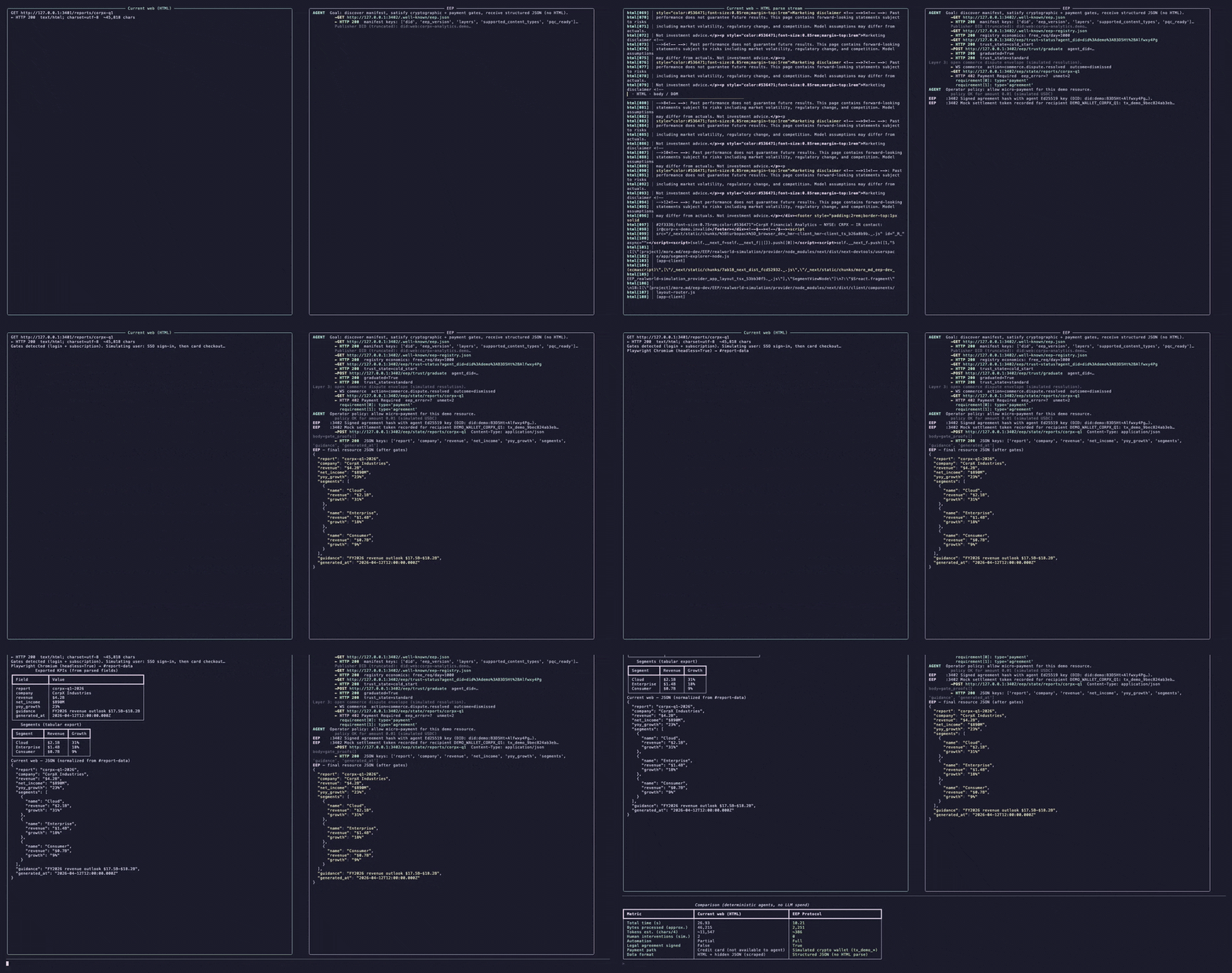
Two agent paths, side by side. Deterministic — no LLM spend. Reproduce it →
Stability (v0.1)
The specification and reference packages are v0.1: the spec, schemas, CI and libraries here are meant to be implemented against, but breaking changes can still happen while the ecosystem is small. Pin versions in production and read CHANGELOG.md before upgrades. Governance details: GOVERNANCE.md.
Community and safety: Code of Conduct · Security (reports: hello@eep.dev with [Security] in the subject) · Releasing (maintainers)
Origins
EEP grew out of engineering work at more.md, where the team built a platform around the idea of one canonical URL per digital entity. Once the protocol stabilized, it was extracted from that codebase, generalized and open-sourced under Apache 2.0 so any publisher and any agent can speak the same wire format. The more.md team continues to maintain the specification alongside the rest of the core team listed in GOVERNANCE.md and operates the production reference implementation that exercises every conformance tier and gate type defined here.
EEP?
MCP, A2A, webhooks and ActivityPub standards solve different problems. EEP composes with all of them.
- MCP lets an LLM call a tool. EEP lets an LLM follow an entity over time — discover it, subscribe and react to verified events from it.
- A2A lets two agents collaborate on a task. EEP defines how either agent learns that an entity changed at all.
- Plain webhooks require a custom protocol per publisher (auth, signing, retries, replay window). EEP is one wire format with HMAC-signed delivery, SSE and a 60-second replay window — implemented once, reusable everywhere.
- ActivityPub federates accounts in a social graph. EEP delivers state-change events from any entity (person org, agent, product, listing) to authorized subscribers, with optional payment / credential / identity gates.
- DIDs and Verifiable Credentials identify who an entity is. EEP defines what they tell their subscribers and how subscribers verify it.
If you are building anything labelled "agentic," EEP is the missing layer between the agent knows about the world (DIDs, MCP, your data store) and the agent reacts when the world changes (today: bespoke per-vendor integrations).
Official repositories
- Protocol and reference code: github.com/eep-dev/EEP
- Landing site: github.com/eep-dev/eep-site
In this repository
If you are deciding whether to star, fork or integrate, here is what is actually here:
| Artifact | Where |
|---|---|
| Normative protocol (v0.1) | docs/current/SPECIFICATION.md |
| JSON Schemas | schemas/v0.1/ |
TypeScript libraries (@eep-dev/*) |
packages/@eep-dev/ |
Python ports (eep-*) |
packages/eep-*-python/ (same scope names, Python packaging) |
| Conformance runner | @eep-dev/compliance-cli |
| MCP bridge (tool runtime ↔ EEP) | @eep-dev/mcp-bridge + eep-mcp-bridge-python |
| HTTP middleware for existing APIs | @eep-dev/middleware + eep-middleware-python |
Project wizard (init / inject / apply / verify) |
@eep-dev/setup-cli |
| Agent adopt (inject → apply → verify → report) | @eep-dev/agent-adopt — see AGENTS.md |
| Adopters (seed list, static JSON) | registry/adopters.json — eep.dev/adopters |
| Day-0 strategy & distribution | docs/strategy/ |
| Docker reference stack (Node + Python + Postgres + Redis) | examples/eep-reference-implementation/ |
| Scripted “Old Web vs EEP” terminal demo | realworld-simulation/ (npm run demo) |
| LangGraph/Claude agent example | examples/langgraph-eep-agent/ |
| Interactive playground (browser) | eep.dev/playground — event validation + HMAC signing |
| How to run tests | TESTING.md |
Nothing here promises a particular ranking, traffic or business outcome. It does promise a documented wire format, libraries you can import and commands you can run to check behavior.
What is EEP?
The Entity Engagement Protocol (EEP) describes how digital entities (people organizations, products, agents) publish state changes and how authorized subscribers receive them as events, with optional access gates (identity, credentials, payment, agreements) and signatures so subscribers can tell real traffic from forgery.
Much of the web still relies on polling or bespoke feeds, so clients often see stale data or one-off integrations. EEP standardizes discovery, subscription, delivery (SSE and webhooks at minimum) and optional WebSocket negotiation so integrations look the same across publishers.
The triple protocol
EEP defines three transport layers for different jobs:
| Layer | Protocol | Role |
|---|---|---|
| State resolution | REST (HTTP) | Discover entities, read capabilities, resolve DID documents |
| Signal stream | SSE + webhooks | Push lifecycle and content events to subscribers |
| Network pulse | WebSockets | Low-latency commands and agent-to-agent work |
Implementations must provide the signal stream. State resolution and network pulse are optional add-ons.
Why it exists
Automated clients (mobile apps, backends or agents) repeatedly hit the same problems: knowing when something changed, subscribing without a custom protocol per publisher and checking that an event really came from that entity. EEP combines shared discovery, push delivery and cryptographic checks.
Publishers and strategists: structured discovery, manifests versus sitemaps and generative engine optimization (GEO) are discussed as industry context in the Whitepaper and non-normative spec notes. GEO is not a conformance test for EEP.
Protocol positioning
EEP is the contract for agent ↔ entity engagement: discovery, realtime streams, gate proofs and payment-aware access. It sits next to other stacks.
| Protocol | Primary scope | Interaction | What it standardizes |
|---|---|---|---|
| EEP | Entity engagement | agent ↔ entity | discovery, streams, gates, commerce handshakes |
| MCP | Tool use | agent ↔ tool/server | tool and resource calls for model runtimes |
| A2A | Agent collaboration | agent ↔ agent | delegation and lifecycle |
| ANP | Decentralized agent networking | agent ↔ agent | DID-centric coordination |
See eep-positioning-complementary.md for a short comparison and
discovery-crosswalk-v1.md for a copy-paste recipe that co-locates EEP,
A2A Agent Card, MCP discovery and llms.txt on a single origin without conflict.
Quick start
Bootstrap (contributors and CI)
bash scripts/bootstrap.sh
Testing
Run the test matrix: TESTING.md
bash test.sh
To run the full test matrix including cross-implementation network tests (this implicitly starts a background server):
bash test.sh --full
For subscribers (sketch)
# Subscribe to an entity stream (webhook delivery)
curl -X POST https://api.example.com/eep/subscribe \
  -H "Authorization: Bearer YOUR_API_KEY" \
  -H "Content-Type: application/json" \
  -d '{
    "source_did": "did:web:example.com:u:acme-corp",
    "event_types": ["com.example.entity.updated", "com.example.trust.changed"],
    "delivery_method": "webhook",
    "delivery_url": "https://your-agent.example.com/hooks/eep"
  }'

# Or open an SSE stream (no webhook)
curl -N "https://api.example.com/eep/stream?source=acme-corp" \
  -H "Authorization: Bearer YOUR_API_KEY"
For platforms (dispatchers)
How to dispatch walks through emitting EEP events from your own stack.
Setup CLI (init, inject, apply)
Use @eep-dev/setup-cli to scaffold a new config (init) or analyze an existing service (inject), then generate artifacts (apply) and validate (verify, doctor, status, rotate-secrets). After apply, you still mount routes in your app: After setup-cli: wire EEP into your app.
cd packages/@eep-dev/setup-cli
npm install
npm run build   # optional; otherwise use npx tsx below

node dist/index.js init --preset exchange --out ./eep-setup.json
# same as: npx eep-setup init …  (after build, from this package directory)
# or: npx tsx src/index.ts init --preset exchange --out ./eep-setup.json

npx tsx src/index.ts inject --project /path/to/existing-api --out /path/to/existing-api/eep-setup.json
npx tsx src/index.ts apply --config /path/to/existing-api/eep-setup.json --dry-run
npx tsx src/index.ts apply --config /path/to/existing-api/eep-setup.json --output /path/to/existing-api/eep-generated
npx tsx src/index.ts verify --output /path/to/existing-api/eep-generated
npx tsx src/index.ts doctor --output /path/to/existing-api/eep-generated
npx tsx src/index.ts status --output /path/to/existing-api/eep-generated
npx tsx src/index.ts rotate-secrets --env /path/to/existing-api/.env
Runtime integration: Node @eep-dev/middleware, Python eep-middleware-python.
WebSocket (network pulse)
// Bidirectional channel for negotiation-style work
const ws = new WebSocket('wss://api.example.com/eep/pulse', {
  headers: { Authorization: `Bearer ${API_KEY}` }
});

ws.onopen = () => ws.send(JSON.stringify({
  v: 1, type: 'system', action: 'subscribe',
  data: { source_did: 'did:web:example.com:u:acme-corp' }
}));

ws.onmessage = (e) => {
  const msg = JSON.parse(e.data);
  console.log(`[${msg.type}] ${msg.action} (seq: ${msg.seq})`);
};
Repository layout
EEP/
├── docs/                              # Spec, guides, ops baselines
│   ├── index.md
│   ├── current/                       # SPECIFICATION.md, MONETIZATION.md, security, delivery_guarantees
│   ├── ops/                           # SLO, incidents, webhooks, observability
│   └── guides/                        # Subscribe, dispatch, testing, enterprise, agents, setup-cli, …
├── schemas/v0.1/                      # JSON Schemas for v0.1
├── packages/
│   ├── @eep-dev/{signer,validator,gates,compliance-cli,discovery,mcp-bridge,middleware,setup-cli}
│   └── eep-*-python/                  # Python ports (naming: eep-gates, eep-signer, …)
├── tests/                             # Schema tests, benchmarks, parity tests
│   └── cross-impl/                   # Pytest suite against any EEP publisher (see README there)
├── realworld-simulation/            # Next.js + Express “Old Web vs EEP” demo
├── scripts/                         # bootstrap.sh, smoke tests, coverage helpers
├── examples/
│   ├── eep-reference-implementation/# Docker: Node + Python APIs + Postgres + Redis
│   ├── eep-middleware-express-mini/   # Minimal middleware wiring
│   ├── node-express-subscriber/
│   ├── node-gate-publisher/
│   ├── python-fastapi-subscriber/
│   ├── python-gate-subscriber/
│   └── cross-impl/                    # Legacy interoperability harness (see its README)
├── test.sh                            # Aggregated test entry
└── TESTING.md                         # Detailed test commands
Packages (summary)
Shipped as npm packages (TypeScript, Node 18+ where noted) with Python counterparts for the same roles:
@eep-dev/signer/eep-signer: HMAC-SHA256 webhook signing and verification (Standard Webhooks aligned usage).@eep-dev/validator/eep-validator: SSRF checks on subscriber URLs and event-type pattern matching before you call out.@eep-dev/gates/eep-gates: gate configs, access resolution, HTTP 402 helpers, commerce transitions.@eep-dev/compliance-cli/eep-compliance-cli: point at a live base URL and run conformance probes (Node CLI targets Node 22+).@eep-dev/discovery/eep-discovery: manifest validation,Linkheaders, DNS TXT.@eep-dev/mcp-bridge/eep-mcp-bridge: bridge MCP tool traffic with EEP.@eep-dev/middleware/eep-middleware-python: drop-in HTTP adapters (Express, Fastify, Hono, Koa; FastAPI, Flask, Django).@eep-dev/setup-cli: project detection, codegen, verify/doctor/watch.@eep-dev/agent-adopt: one-shotinject+apply+verify, optional framework patch,EEP_ADOPTION_REPORT.md.
@eep-dev/signer
import { EEPSigner, verifyEEPWebhook } from '@eep-dev/signer';

const sig = new EEPSigner(secret).sign(webhookId, timestamp, body);
const ok = verifyEEPWebhook(rawBody, req.headers, secret);
@eep-dev/validator
import { validateSSRF, matchesAnyPattern } from '@eep-dev/validator';

await validateSSRF(deliveryUrl); // throws if unsafe
const match = matchesAnyPattern('com.example.entity.updated', ['com.example.entity.*']);
@eep-dev/compliance-cli
npx @eep-dev/compliance-cli --target https://api.yourplatform.com --api-key sk_... --entity u/test
Probes cover discovery, subscription, WebSub verification, signatures, CloudEvents envelopes, SSE and rate-limit headers. Use --report-json / --report-md for CI artifacts.
@eep-dev/discovery
Manifest validation, Link header parsing and DNS TXT parsing for discovery documents.
@eep-dev/gates
import { parseGateConfig, resolveAccess, build402Response, transition, ProofVerifierRegistry } from '@eep-dev/gates';

const config = parseGateConfig(entityGateJson);
const registry = new ProofVerifierRegistry();
registry.register({
  supportedTypes: ['payment'],
  verify: async (proof) => Boolean((proof as { token?: string }).token),
});

const result = await resolveAccess(agentProofs, config, 'content.papers.full_text', registry);
if (!result.granted) {
  const body = await build402Response(config, 'content.papers.full_text', agentProofs);
}

const t = transition('open', 'accept'); // { valid: true, to: 'accepted' }
Tier types include payment, trust, identity, credential, connection, capability, allowlist, reciprocal, custom x-* and combined tiers (see spec and tests for exact rules).
Reference deployment
EEP ships with two reference deployments at different levels of completeness:
- In-tree minimal stack — examples/eep-reference-implementation/. A small Node + Python + Postgres + Redis Compose project used by contributors and CI to exercise Layer 1 discovery, Layer 2 subscribe/stream, Layer 3 pulse and the gate endpoints against shared parity fixtures. Smoke script from repo root:
bash scripts/eep-reference-smoke.sh(see Five-minute proof). - Production reference — more.md — the platform where EEP originated. It runs every conformance tier (Core, Standard, Full), all gate types (credential, identity, agreement, data_request, payment, trust, allowlist, reciprocal, custom
x-*), the commerce state machine and the WebSocket pulse end-to-end in production. Implementors who want to see EEP exercised at full scope can point clients and@eep-dev/compliance-cliat a more.md endpoint.
The minimal stack is sufficient to read the spec and run conformance probes locally; more.md is the reference for what a complete EEP deployment looks like in production.
Conformance levels
| Level | Includes |
|---|---|
| Core | Layer 1 (/.well-known/eep.json) + Layer 2 SSE + valid DID document + content negotiation |
| Standard | Core + webhooks + credential/identity/payment gates + EEP version negotiation |
| Full | Standard + Layer 3 WebSocket + commerce state machine + agreement + data_request gate + session persistence + W3C DPV-oriented fields |
npx @eep-dev/compliance-cli --target https://api.yourplatform.com
Publishers should enforce per-subscriber 429 limits with Retry-After and X-RateLimit-*; numeric quotas stay implementation-defined.
Governance and planning
EEP uses a BDFN model for 0.x and plans a steering committee at v1.0. Details: GOVERNANCE.md.
- ROADMAP.md — milestones for v0.2, v0.3 and v1.0 (TSC formation, IETF/W3C submission, foundation transition)
- MAINTAINERS.md — current maintainer tiers and per-package ownership
- CHANGELOG.md — Keep-a-Changelog-style release notes
- eep-site sync checklist — keep landing-site copy in lockstep with the spec
- arXiv packaging notes — for the whitepaper
- ADOPTERS.md — optional public list; PRs welcome
Roadmap and adoption
Completed in-tree:
- Python ports for gates, signer, validator, compliance CLI, discovery, MCP bridge and middleware (see
packages/eep-*-python/). - Cross-implementation HTTP tests (tests/cross-impl).
- Python gate subscriber example (examples/python-gate-subscriber).
Further reading:
- How to use the Setup CLI
- After setup-cli: wire EEP into your app
- Five-minute proof
- Realworld simulation and realworld-simulation/README.md
- Enterprise implementation playbook
- Agent onboarding
Contributions: CONTRIBUTING.md.
License
Apache 2.0. See LICENSE.
Similar projects


Give AI agents access to money 💰1,100+ MCP tools — swap, bridge, stake, lend, trade, and deploy across most blockchains. The open MCP gateway where AI meets DeFi. Trade crypto, swap across DEXs, bridge chains, stake tokens, lend, track whales, read market news, analyze smart contracts, pay other agents autonomously via x402.


Send Nano currency from AI agents/LLMs


A collection of Summoner clients and agents featuring example implementations and reusable templates


A protocol and node for a bot economy — bots create, publish, discover, buy, sell, and compose remote resources for value.


Open-source Solana AI agent protocol for escrow payments, reputation, disputes, and autonomous service coordination.


Open-source Solana AI agent protocol for escrow payments, reputation, disputes, and autonomous service coordination.

More LLM projects
All LLM projects →


The agent-native LLM router for autonomous agents. 55+ models (8 free), <1ms local routing, USDC payments on Base & Solana via x402.


The living ecosystem where AI agents complete tasks through workflow loops, improve through iterative execution, are evaluated by mentor agents or humans in the loop, and turn completed work into reusable work experience and data to improve future agents.


Self-healing infrastructure for AI agent payments. 90.3% auto-recovery.

The AI agent with a wallet — spends USDC autonomously to get real work done. Apache-2.0, TypeScript.

Daydreams is a set of tools for building agents for commerce

Live data for AI agents — search, research, markets, crypto, X/Twitter. Pay-per-call via x402 micropayments.